

How a car is made: the journey from auto parts to finished vehicle
From the birth of automobiles in the 19th century, the vehicle production chain has undergone an impressive evolution. And it has done so in leaps and bounds since Henry Ford laid the foundation for mass production. In its early days, car manufacturing was carried out manually by a few operators in a workshop. These were simple vehicles intended for the local market, and their production numbers were very limited.
Today, we are talking about a large, interconnected network involving numerous suppliers located all over the world and relying on some of the most advanced technological infrastructures in the industry. Did you know that component manufacturers contribute more than 75% of a vehicle’s total value? Companies like Teknia work every day to manufacture and continue driving the mobility of today and tomorrow.
Stages of the Vehicle Production Chain
The creation of a new car model involves thousands of hours of work and testing, essential throughout the development and design process of the new vehicle. Once this development phase is completed, manufacturing begins. This stage requires coordinating multiple suppliers located in different geographic regions, and often also adapting production plants to the needs of each project. In addition, the companies involved in vehicle manufacturing face a range of challenges such as globalization, regulations, sustainability, technology, and innovation.
Join us as we explore each stage of the vehicle production chain:
Raw Materials: The Starting Point
The vehicle production chain begins with the extraction and processing of raw materials. Today, steel and aluminum are two essential materials in car manufacturing, primarily forming part of the chassis and bodywork. Aluminum, in particular, is gaining more importance in the industry thanks to its lightness and strength.
The expansion of electrification has made aluminum a crucial raw material for reducing vehicle weight, thereby improving fuel efficiency and the range of electric vehicles.
A Wide Range of Suppliers Bring Vehicle Components to Life
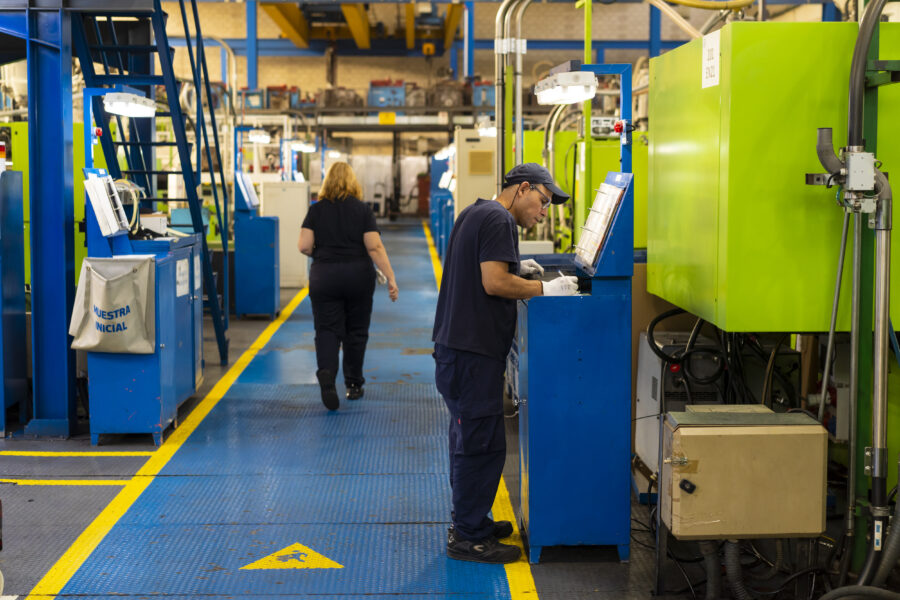
Component suppliers are responsible for transforming various raw materials into finished parts that will later be assembled into the final vehicle. At Teknia, we have over 30 years of experience in the sector and offer a broad multi-technology portfolio, which includes tube forming, metal stamping, High Pressure Die Casting, machining, and plastic injection.
The automotive component manufacturing ecosystem is organized into several levels:
-
Tier 1: These are the direct suppliers to car manufacturers, also known as OEMs (Original Equipment Manufacturers). Tier 1 suppliers develop large or complete assemblies such as chassis and body structures.
-
Tier 2: These companies supply Tier 1 suppliers and may also work directly for OEMs. They usually produce smaller, more specific components — for example, gears or various electronic, interior, exterior, or safety components.
-
Tier 3 and beyond: These supply Tier 2 companies with highly specific parts.
This vast network of suppliers, comprising thousands of companies, highlights not only the complexity of the vehicle production chain but also its international nature. The supplier industry, which contributes more than 75% of the vehicle’s value, operates with advanced technology, precision machinery, and strict quality controls.

Assembly: The Key Step in the Vehicle Production Chain
Once the thousands of parts that make up a vehicle are produced, they are shipped to the car manufacturer for assembly. This is probably the most well-known part of the production chain, although few people realize that it consists of several phases. In each one, humans, machines, and cutting-edge robots work together to create the final vehicle.
In fact, today’s plants — both those of component suppliers and car manufacturers (OEMs) — are true examples of digitalization and automation.
A More Circular Vehicle Production Model
It is impossible to talk about the vehicle production chain without emphasizing its increasingly circular nature. Both European regulations and the environmental awareness of industry and society demand that a large part of the materials used in car manufacturing be recovered and recycled at the end of a vehicle’s life cycle.
Once the vehicle reaches the end of its useful life, the different materials that make up its components are separated and processed so that they can be reused in the manufacture of new vehicles or other components. For example, in its HPDC technology processes, Teknia uses 100% recycled aluminum without compromising quality. This final link closes the loop and reduces dependence on virgin raw materials.
Interested in our Press Kit?
